Wednesday, November 27, 2013

Gionee Elife E7 Officially Announced: Specs, Price, India Release Date And Competition

          Chinese smartphone manufacturers have been excelling in the business quite well these days. Following the footsteps of Huawei which has already occupied the third position in the global smartphone market share in Q3, Gionee also looks to capture some market share and has announced the their latest handset in the Chinese market.
          The device that was unveiled in Shanghai yesterday comes dubbed as Elife E7, the proud successor of E6. Talking about the specs, the handset comes with a 5.5-inch Full HD (1920 x 1080 pixels) IPS touch screen display based on One Glass Solution from JDI with Corning Gorilla Glass 3 protection and a 2.33mm ultra-narrow frame.
           Powering the handset is Qualcomm's most powerful 2.2 GHz quad-core Snapdragon 800 MSM8974 processor. However this processor is meant for just the 3G variant of the handset. While the 4G LTE version will be clocked to 2.5 GHz quad-core Snapdragon MSM8974AC processor. Both the variants of the handsets run on Android 4.2 (Jelly Bean) OS with a layer of Amigo 2.0 UI.


          Moving on to the imaging domain, the Elife E7 features a 16-megapixel auto focus rear camera with 1/2.3″ 1.34 µm Largan M8 sensor, 5 element Sapphire Lens and a unique and stunning 8-megapixel auto focus front-facing shooter. Again, Gionee Elife E7 comes in two variants 2GB RAM with 16GB internal memory and 3GB RAM with 32GB internal memory.
          Connectivity options include LTE/3G, WiFi 802.11 b/g/n, WiFi Direct, Bluetooth 4.0, GPS, USB,OTG and NFC. Further, Elife E7 measures 150.6 x 75.0 x 9.5mm-6.2mm and weighs 150 grams and draws its energy from a 2500 mAh built-in battery. Concerning the UI features, Elife E7 has new ways to wake up the screen such as Double Tap, Black Screen Gesture that lets you draw the gestures on the black screen to go to customized apps and Voice Control. On top of that, this handset also incorporates 3 microphones for noise cancellation as well.
           The Elife E7 comes in Black, White, Blue, Green, Orange and Red colors and is priced at 2,699 Chinese Yuan (approx. Rs. 27,665) for the 16GB variant and the 32GB variant will cost 3,199 Chinese Yuan (approx. Rs. 32,790). It would be available for pre-order in China later this month and would go on sale on December 12. The Gionee Elife E7L with LTE support would be available in the first quarter of 2014. The Elife E7 would launch globally in the early 2014 including India. Gionee has also announced that the company would launch the E7 mini with a Mediatek octa-core chipset in the coming months.
          
           Amid growing popularity of phablets in India, it is for sure that Gionee Elife E7 will have to face a tough battle in the market from lot of others which comes from the roots of strong tech manufacturers. First of all the major native rival Huawei will be one with utmost concern. Others like Samsung and LG will also be suffering.
          If the device comes in India, it will rival with almost all the Indian premium handsets like Micromax Canvas Turbo and Karbonn Titanium S7 as well. But GizBot has chosen Samsung Galaxy Note 3, Lenovo K900, LG Optimus G Pro, Galaxy Note 2 and also Sony Xperia Z Ultra as its potential rivals. All these devices come with a similar size and features somewhat similar specs as well. There are differences in the price.

Key specs: Gionee Elife E7

Tuesday, November 26, 2013

                               Google Nexus 5  


              The Google Nexus 5 is the fifth generation of the Google-designed Nexus Android smartphone line, which is now faster, slimmer and even better.
              The Nexus line represents the best of Google in a smartphone. Google chooses a manufacturing partner – in this case LG as it did with the Nexus 4 before it – and gets involved directly with the creation of the hardware as well as producing the software.
              It is Google hardware, running Google software, and is as close to the iPhone’s one-company manufacturing model as is possible with Android. The Nexus 5 is built by LG, but it is a Google phone through and through.
              As with previous generations of Nexus smartphones, the Nexus 5 is based on pre-existing internal hardware from LG – in this case the LG G2. That’s a good thing, as the LG G2 is a superb phone hampered with poor software integration, something Google can completely iron out with its Nexus line of phones.


              The Nexus 5 is, as the name might suggest, a 5 inch phone. It is a relatively small 5 inch phone, however, as there is barely any bezel around the screen’s left and right hand sides. The bezel above and below the screen is about one little finger’s width, and holds the speaker, front-facing camera and ambient light sensors up top, with the notification LED at the bottom.
               It is worth noting that a 5 inch phone is quite hard to use one-handed if you have small hands. With my average-sized hands, I can more or less reach every corner of the screen with my thumb, but it can be a bit of a stretch. It is a trade off for a large screen, but for those moving from a 3.5 or 4in phone like the iPhone 5, it certainly takes some adjustment.
               The phone looks rather understated and plain in black – not something that is necessarily bad – although a white model is also available. Short of the glass front, the rest of the phone is coated in a soft-touch plastic, which feels almost silky in texture and provides a good balance between being smooth and having enough friction to stop the phone sliding out of your hand.


               A rounded back to the phone also feels very nice in the palm of your hand, while the light 130g weight makes the phone easy to hold one-handed. For comparison, the similarly shaped HTC One weighs 143g, while the Samsung Galaxy S4 weighs 130g, and the smaller iPhone 5S 112g.
               Short of the Nexus logo, a small rear camera bulge in the top left-hand corner is the only feature of note on the back. It means the phone rests on it when laid down flat, which is an odd choice giving it little to no protection.
               The front of the device is dominated by the 4.95 inch screen. It is a pin-sharp full HD IPS Plus LCD display, which means text on websites and eBooks looks crisp and easily legible, with photos and videos looking detailed and colorful. The screen is also very bright, making it much easier to read in direct sunlight than some competing screens on other device

Specifications:

Height
137.9mm
Width
69.2mm
Thickness
8.6mm
Weight
130g
Size
4.95-inch
Resolution
1920 x 1080 pixels, 445ppi pixel density
Colours
16M
Battery capacity
2300 mAh
Standby
Up to 300h
Talktime
Up to 17h
Processor
Qualcomm Snapdragon 800 2.3 GHz quad-core chipset
OS
Android 4.4 KitKat
RAM
2 GB
Internal storage 16 GB / 32 GB
Network
4G LTE
Camera resolution
8-megapixel, 3264 x 2448 pixels, OIS, auto focus, LED flash, 1080p video recording at 30fps

Battery is a little inconsistent, but alright:

              This brings us to the battery. When testing the Nexus 5’s camera, around 40 shots and a single, one minute video were taken. A few were shared on several social networking sites, emails were read, apps installed and messages sent. After five hours, the battery was down to 47 percent. Add in some gaming in the afternoon, and the phone needed to visit the charger in the late evening. Not terrible, but not great. Light use during another day indicated the battery should last for two days before needing a recharge if you don’t use it a lot.

Conclusion
              To judge the Nexus 5, we need return to the Nexus 4 for a moment. For all its greatness, the year-old phone failed to break into the mainstream, as regular buyers still flocked to Samsung for their Android smartphone fun. Is the Nexus 5 Google’s breakout device, ready to take on the accepted giants of the industry, such as the Galaxy S4 and the HTC One? At $350 unconnected for the 16GB model, it has every right to popularity; it’s half the price of its competitors. It’s also just as powerful with a screen just as sharp, and the standard Android user experience is far better than any manufacturer user interface we’ve used.
However, its limited availability with carriers in the United States is a problem. Sprint and T-Mobile are the only carriers that will sell it in-store, and the benefits of standard Android are irrelevant to most people. All this would be solved if the Nexus 5 stood out for some other reason than its SIM-free price. But instead, it’s a bit too safe in its feature list and design. It’s vaguely related to the LG G2, which will look considerably more “exciting” to buyers, thanks to the rear-mounted buttons and attention grabbing (though largely useless) extra software features.
   The Nexus 5 then, will probably remain the Android phone of choice to those in the know, or bargain hunters who do their research. It’s unlikely to be challenging high-selling Samsung phones for supremacy. Don’t get us wrong, it’s a comprehensive upgrade over the Nexus 4, can match the pace of phones costing twice as much, and those who do buy it will get themselves one of the best Android phones available. But this phone won’t set your heart a-flutter. The Nexus 5 is a no-nonsense smartphone which shows off everything Android (and LG, to an extent) is capable of in a most convincing, but clinical, fashion. Just don’t let that put you off.

Highs
  • Gorgeous screen
  • Android 4.4 is the best version yet
  • Nexus phones get updates straight from Google
  • Tightly integrated voice control
  • Solid build quality
  • Ultra-competitive $350 price
Lows
  • Boring design
  • Lacks the wow factor
  • The camera, though improved, isn’t fantastic
  • SMS integration into Hangouts needs work
  • Battery life is inconsistent


Micromax Canvas HD A116i with quad-core processor available online


Micromax has introduced the Canvas HD A116i, the successor to the Canvas HD
 smartphone for the Indian market. The Canvas HD A116i is listed at eCommerce website.

The Micromax Canvas HD A116i runs Android 4.1.2 Jelly Bean, with the listing claiming that the company plans to roll-out an update to Android 4.2.1 soon. Much like the Canvas HD, it is a dual-SIM device with support for GSM+GSM. The Canvas HD A116i is powered by a MediaTek's MT6589 quad-core processor clocked at 1.2GHz along with PowerVR SGX544 GPU and 1GB of RAM. The smartphone features a 5-inch display with a resolution of 720x1280 pixels and boasts of a pixel density of 294ppi.

            For optics, there is an 8-megapixel rear shooter with LED flash and 4X zoom, and a 2-megapixel front-facing camera. There is 4GB of inbuilt storage, which is further expandable up to 32GB via microSD card. Connectivity options on the smartphone include Bluetooth, Wi-Fi, GPRS, EDGE and 3G. There is no mention of the battery included on the Canvas HD A116i.

           Looking at the specifications, we are unable to see the difference between the predecessor and successor, and perhaps the only unmentioned detail, battery capacity, might be the singular change in the models, with the A116i expected to bear a larger battery. Micromax announced the Canvas HD in February this year.Previously, on Monday, Micromax's new budget smartphone, the A77 Canvas Juice was listed online at Rs. 7,999. The Micromax A77 Canvas Juice runs Android 4.2 Jelly Bean and is a dual-SIM phablet with support for GSM+GSM and dual standby. It features a 5-inch FWVGA display with 480x854 pixels resolution. The phablet is powered by a dual-core 1.2GHz processor along with 1GB of RAM.

            It sports a 5-megapixel auto focus rear camera accompanied by an LED flash and also includes a VGA front-facing camera. It comes with 4GB inbuilt storage, which can be expanded up to 32GB with the help of a microSD card.


Micromax Canvas HD A116i key specifications:
  • 5-inch HD (1280 x 720 pixels) display
  • 1.2 GHz quad-core MediaTek MT6589 processor
  • 1GB RAM
  • 4GB inbuilt storage, expandable up to 32GB via microSD card
  • 8-megapixel rear camera
  • 2-megapixel front camera
  • Dual-SIM (GSM+GSM)
  • Android 4.1 planned Android 4.2 upgrade

Samsung Galaxy Core Plus

Samsung Galaxy Core Plus


Samsung Galaxy Core Plus  Specs Details :


Samsung has announced the new version of Galaxy Core Smartphone, the Galaxy Core Plus. The Core has a 4.3 inch display with 800 x 480 resolution, with Gorilla Glass protection. The design of the smartphone is made of plastic, as expected, and the phone is overall 9.5mm thick and 132.5g in weight. 


On the hardware side of things, it comes with a 1.2Ghz Cortex A5 processor with 768 MB worth RAM (against the 1GB memory of the Core) and 4 GB internal storage (8 GB is found in the Core), expandable up to 64GB via a microSD card slot. 


Towards the back, the phone comes with a 5 megapixel camera with 720p HD video recording, along with a VGA front-facer. Connectivity options include Bluetooth 4.0, Wi-Fi 802.11, NFC, GPS, 3G and FM Radio. 


The OS with which the phone will come at launch will be Android 4.2 Jelly Bean. The phone will be available in Black, White and Pink color options upon release and will set you back by $270. 


Samsung Galaxy Core Plus Key Features :


  • Android 4.2 Jelly Bean customized with TouchWiz UI 
  • 4.3 inch display with 800 x 480 resolution and Gorilla Glass 
  • 9.5mm thick 
  • Weight: 132.5g 
  • 1.2Ghz Cortex A5 processor with 768 MB RAM 
  • 4 GB internal memory expandable by 64GB via memory card 
  • 5 megapixel rear-camera with 720p HD video recording 
  • VGA front-facing camera 
  • Bluetooth 4.0, Wi-Fi 802.11, NFC, GPS, 3G, FM Radio 
  • Available in Black, White and Pink flavors

Gionee Elife E6 Review

Amongst the many upstarts in the indigenous smartphone scene in India, one specific brand has caught our eye. Gionee has differentiated itself with its refreshing focus on design and hardware quality. Handsets like Elife E3 stood out from the competition being a device that both looked and also offered a very unique experience to the user. With the Elife E6, Gionee is kicking this up a notch. We’d previously done a preview of the device and here’s our review of the Gionee Elife E6.
Video Review
Hardware
The company’s flagship device sets the benchmark very high for design in mid range handsets. The phone has a unibody form factor with sharp and clean lines. The material is polycarbonate and feels reassuringly solid. The handset weighs deceptively light.
The front of the phone is reminiscent of the iPhone. Indeed, the handset appears to be a much enlarged version of Apple’s popular smartphone. The screen is a 5 inch panel and is absolutely stunning but more on that later. Above the display is the speaker grille and next to it is a front facing camera. An RGB notification LED lies at the far right corner.
Over on the right side of the phone you spot the volume rocker that lies almost flush with the handset but still manages to provide decent feedback. On the left side you spot the iPhone style SIM card slot. You’ll need a pin to extract your micro SIM card from here.  There are no slots for microSD cards on this phone so you’ll have to make do with the built in storage.
Over at the top is the the 3.5mm audio jack and the power switch. The power switch is slightly off center but not entirely to the right. While holding the phone, your finger rests naturally on top of the button. It is interesting to see this level of attention to detail that is not very common outside of the top smartphone brands. At the bottom is the micro USB slot with the two speaker grilles next to it.
The back of the handset is a swathe of pearly white plastic with a high gloss finish. Surprisingly, this does not look tacky at all. The high quality plastics used ensure that the handset in fact looks and feels just as good as a top end Lumia device that uses similar materials. To the top left corner is where you see the 13MP camera with a single LED flash. The Gionee Elife E6 is a stunning device with a slim 8mm profile that manages to slip into any pocket. Yes, the handset does have a fairly large footprint but that’s true for most phones with a 5 inch display.
Software
While the specifications of most phones are at par, software is often the differentiating factor. On the Gionee Elife E6, this is truer still. The handset runs a fork of Android called Amigo. The system has been built on top of Android 4.2 and offers deep rooted battery optimizations. The interface is visually appealing and follows similar interface principles as the iPhone. There are animations aplenty and that’s where things start to break down a bit. We’ll talk about that in the performance section but for now, let’s walk through the interface of the Elife E6.
Gionee-Elife-E6-UI-2
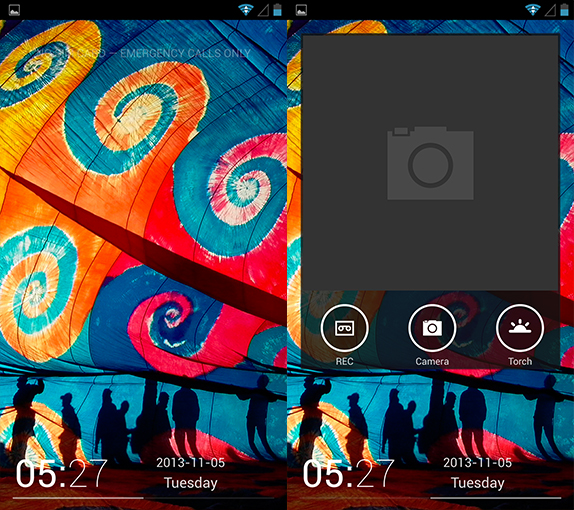
The lockscreen on the E6 is the first thing that you notice on the phone. It is a very clean and modern looking affair though information junkies might not be too impressed. Swiping over from the right brings you a widget that lets you toggle on the torch, camera or sound recorder directly. Worth noting is that the camera toggle does not trigger the full app instead opens the viewfinder in the small space above it.
Gionee-Elife-E6-UI-1
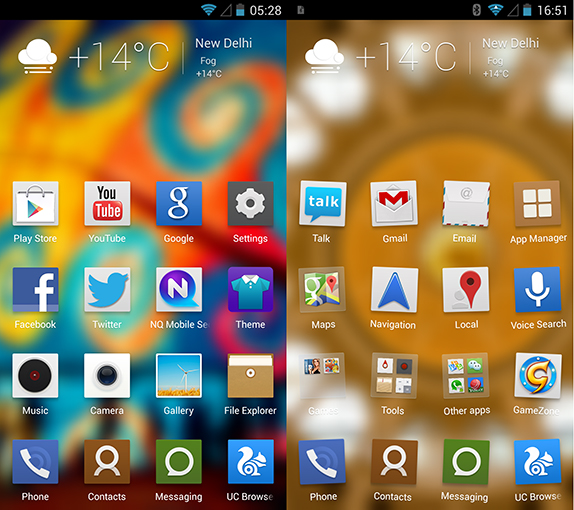
What strikes you at first glance is that there is no application sub menu in the interface. Like on iOS, all application icons are placed on the homescreen launcher directly. A perpetual weather widget is placed at the top of the homescreen and below it are app icons. You can drag and drop them on top of each other to place them into folders. At the bottom is a row of persistent icons that is set to the dialer, contacts, messaging app and UC browser by default but you can switch this out for anything else.
Gionee-Elife-E6-UI-3
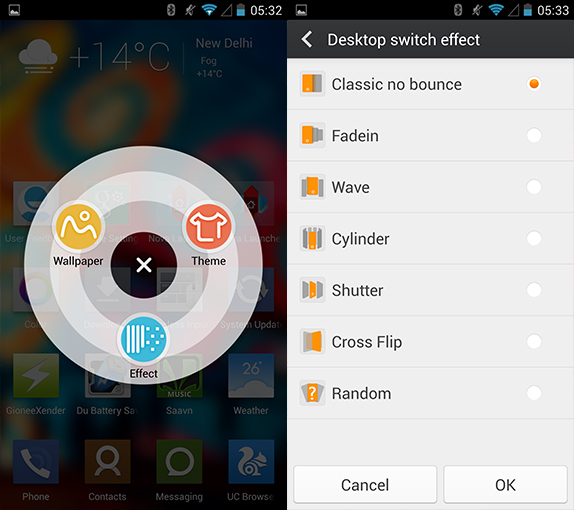
Customization includes the ability to switch out the theme, wallpaper as well as transition effects. The themes essentially consist of preset variations on the effects, wallpapers. We’d recommend sticking with the ‘no bounce’ effect as the others do take a fairly heavy toll on performance.
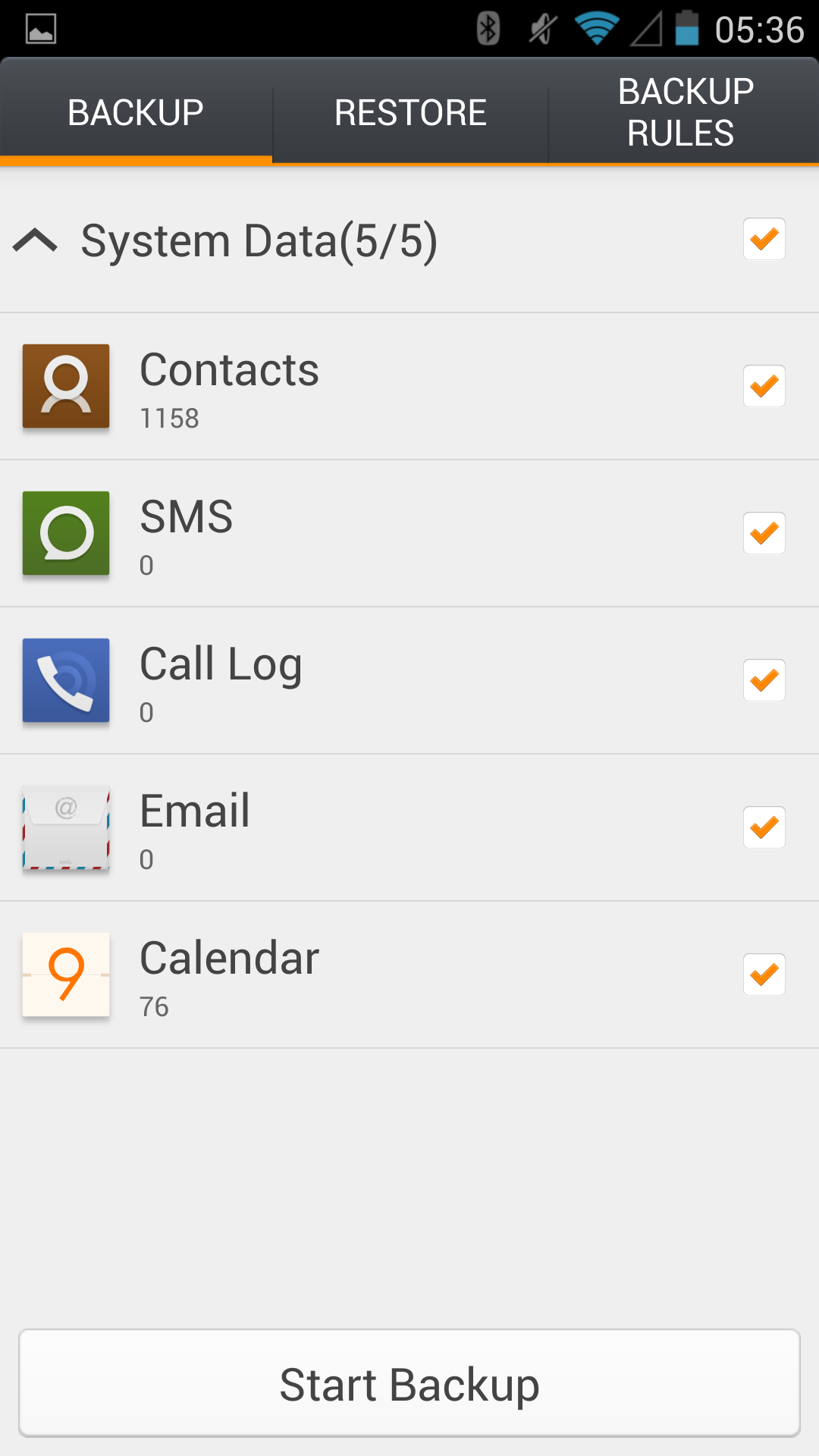
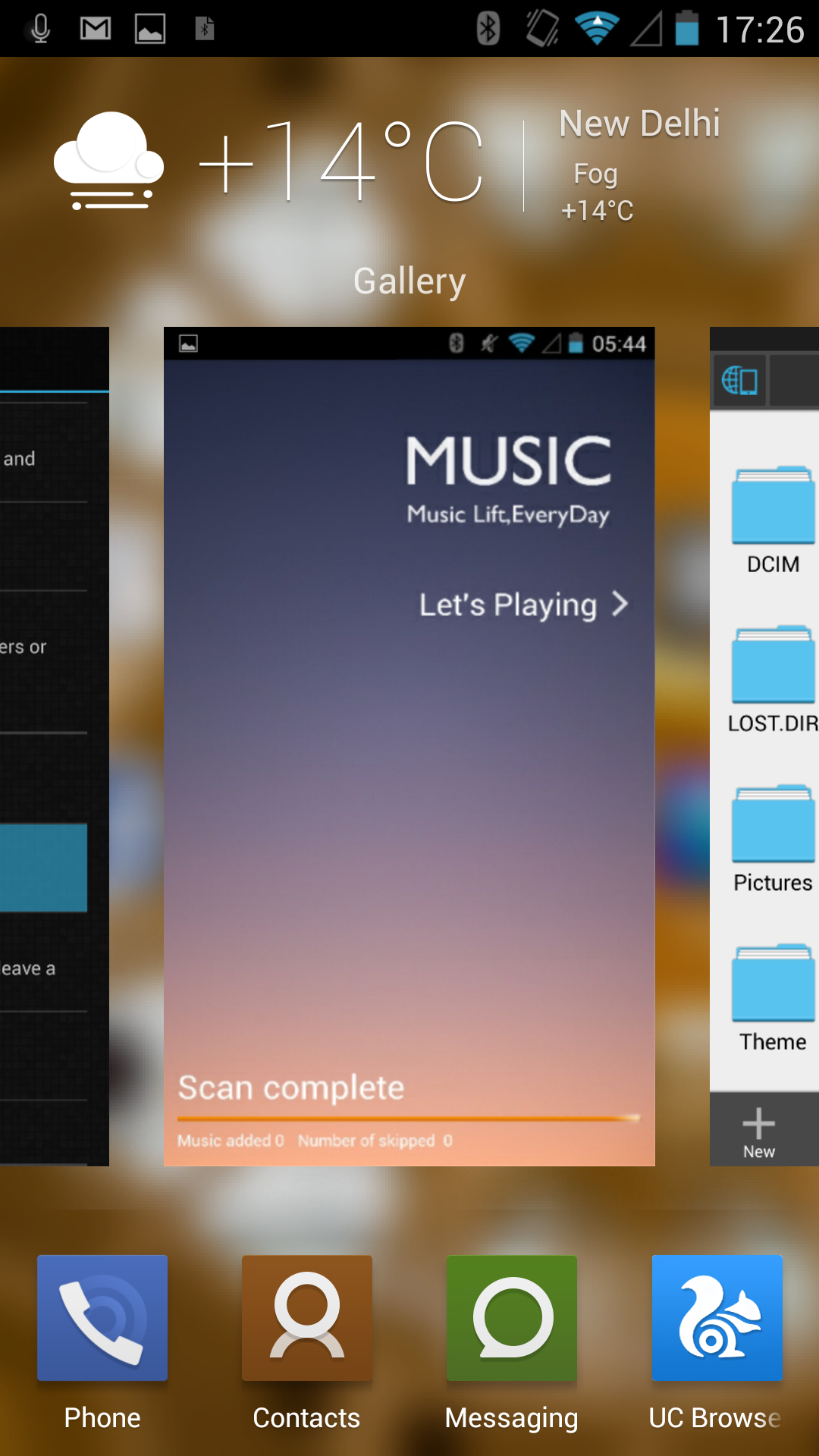
Gionee’s Android fork includes a backup utility built in as well as gestures support. These make use of the accelerometer and / or the front camera and your experience with them will vary though they work well enough for the most part. The multitasking menu has been switched to a card switcher that once again reminds you of iOS and in this case, Windows Phone. We’re not entirely sure this was a good move either as unlike the default Android app switcher, this one requires a lot of scrolling if you have multiple apps open. Overall there are some curious design choices that permeate throughout the operating system. The interface looks really good and borrows elements from the many different skins on other phones. This amalgamation however results in a skin that is heavy on graphical elements, transitions and has a negative effect on performance.
Performance
Moving on to performance, the handset is powered by a 1.5Ghz Quadcore MediaTek MT6589T processor paired with a PowerVR SGX 544MP GPU. There’s 2GB of RAM and 32GB of built in storage. Of this, about 23GB is available. While the specifications on paper sound quite adequate, the fact of the matter is that the interface layer on the phone is just a bit too heavy for the processor to handle. As it is, the MT6589T chip struggles with a stock Android build when paired with a Full HD display, here the added animations cause the phone to stutter through out the interface.
Applications on the other hand are smooth for the most part. Using an alternate launcher is a good way to hide the interface lag related problems. While not very indicative of real life performance, you can check out some of the synthetic benchmark results below.
In the CPU centric Quadrant benchmark, the phone does fairly well and is ahead of most of the competition with a score of 4720 points. The Elife E5 manages to rank further up though because of the lower resolution screen that it has to power and hence better performance.
We see the same trend continue with AnTuTu as well wherein the phone performs quite well and is ahead of most of the competition with a score of 14546. That said, the two competitors above the E6 beat it by a fair margin.
The NenaMark 2 benchmark reveals the sore point in the hardware of the Elife E6. The GPU isn’t really up to the job of powering a Full HD panel and when encumbered with the heavy skin as seen here, it has a direct effect on performance.
We tried out some games on the device. Here is the Shadow Gun gameplay on the Elife E6. The gameplay and the graphics were smooth.
Check out the Ashphalt 7 gameplay. The graphics were good, but the gameplay was laggy.
Check out the Gaming review which test the gaming performance of the device with games such as Riptide GP2 and Iron man 3. Overall the gaming performance was average with occasional lags.
Display
Without a doubt, the screen on the Gionee Elife E6 is gorgeous. In fact, it is one of the most beautiful displays we have seen on any phone. The resolution is 1920 x 1080 and pixel density amounts to ~ 441ppi. Color reproduction tends to be a bit oversaturated but brightness levels are top notch. The display also has some of the widest viewing angles we’ve experienced lately.
Sunlight visibility is good but not the best but that’s a formula that only Nokia seems to have perfected so far. Put next to Full HD display phones from the likes of HTC and Samsung, the panel on the E6 shines and gives them a stiff competition. The screen is of the One Glass Solution (OGS) variety that has a bonded glass and display panel. This ensures better viewing angles and brighter colors.
Camera
Gionee is sourcing the 13MP camera modules from Sony and it has second generation BSI technology for better low light imaging. The camera module sourced from Sony has the Exmor R sensor. Despite that we weren’t too impressed by shots from the phone, images in anything but excellent lighting show grain and inaccurate white balance.
IMG_20131105_155538
As can be seen above, the camera struggled with the shot and a lot of details were lost especially in the green areas due to rather aggressive noise reduction algorithms.
IMG_20131105_160118
The limited dynamic range was visible here as the camera has completely overblown the highlights and has lost all details in the background.
IMG_20131105_163636
Macro focussing on the camera is pretty decent and you can get close up shots quite easily. You’ll want to hold the phone very steady though as the shot to shot time isn’t the fastest and images tend to turn out blurry.
Video quality is decent though we noticed that framerate drops were fairly often. An EIS (Electronic Image Stabilization) mode is also available that we found to be surprisingly effective in removing camera shake given the lack of optical image stabilization in the module.
Battery Life & Connectivity
The Gionee Elife E6 is equipped with a 2000 mAh battery that generally proved to be enough for a day of fairly heavy usage. You’ll definitely have to charge it up overnight though. Software optimizations on the phone play a major role. Gionee claims that the handset will lose a very minimal charge even when keep on standby for long durations. Other optimizations include active management of connections to facilitate longer battery life. Overall we were fairly satisfied by the results we got here. Connectivity options include  3G, WiFi 802.11 b/g/n, Bluetooth 4.0 and GPS. The sensors onboard range from Proximity sensor to the G-sensor, E-Compass, Gyroscope Sensor and Light Sensor. There’s 32GB of storage on the phone of which about 23 is available and you cannot expand this either.
Conclusion
The Gionee Elife E6 is part of a rare breed of phones that have a very design oriented bent. The handset has a design that can possibly be termed as an instant classic. Not only is it ergonomic but also genuinely beautiful though perhaps not the most original. However that’s where majority of the positivities end for the most part.
The performance is middling and the processor isn’t really up to the task of powering the Full HD panel. More so with the heavy animations and transition effects across the interface. The camera module too doesn’t really impress. If your requirements from a phone are fairly minimal and all you want is a sleek and fashionable Android phone, then the Gionee Elife E6 will definitely fit the bill but performance junkies might want to look elsewhere. The Elife E6 retails for Rs. 22,999.
Pros
  • Beautiful hardware
  • Visually attractive interface
  • 32GB storage
Cons
  • Performance
  • Average camera
  • No expandable storage